Thursday, 7 December 2017

Bibliography

BOOKS

Arthur A. (2006). Raney and Jennings Bryant discuss this in Handbook of Sports
and Media .

Berger, J. (1990). Ways of Seeing.

Branston, G (1996). the Media Student's Book Third Edition .

Dines, G. McMahon Humez, J. (2003) Gender, Race, and Class in Media: A Critica
Reader 

Gauntlett, D (2002). Media, gender and Identity 
.
           Hall, S., Evans, J., & Nixon, S. (2013). Representation. London: Sage.

Humez, D. G. (2003). Gender, race and class in Media: A critical reader.

LCEY, N. (1998). Image and Represenattion Key Concepts in Media Studies .
Lehman, P. (n.d.). Masculinity .

MacKinnon. (2003). Representing Men: Maleness and Masculinity in the
Media. London: Arnold.

Prono, L. (2007). Encyclopedia of gay and lesbian popular culture .
 Potter, M. (2006). Rap and the eroticizing of black youth. IL: African American
Images.

R, H. (1995). Male Myths and Icons: Masculinity in Popular Culture .

Sears, D. O. (1999). Radicalized Politics: The Debate about Racism in America 

Vokey, M., Tefft, B., & Tysiaczny, C. (2013). An Analysis of Hyper-Masculinity in Magazine Advertisements. Sex Roles. Retrieved November 16, 2017.

           Wolf, N. (2013). Fire with Fire: New Female Power and How It Will Change the Twenty-First Century. New York City: Random House.

            Lee, S., & Aftab, K. (2005). Thats my story and Im sticking to it. London: Faber   and Faber.

            Mennel, B. (2012). Queer Cinema: Schoolgirls, Vampires, and Gay Cowboys. New York, NY: Wallflower Press.

            Morland, I. (2007). Queer theory. Basingstoke: Palgrave Macmillan.

           Reid, M. A. (2005). Black lenses, black voices: african american film now. Lanham, MD: Rowman & Littlefield .


            Shary, T., & Muse, P. (2013). Millennial Masculinity: Men in Contemporary American Cinema. Wayne State University Press. 


-------------------------------------------
JOURNALS:


           Rose, S. (2017, November 20). From Ex Machina to Moonlight: how A24 disrupted Hollywood. Retrieved November 23, 2017, from https://www.theguardian.com/film/2017/nov/20/ex-machina-moonlight-how-a24-disrupted-hollywood

           Film Theory and Language. (n.d.). Retrieved November 23, 2017, from http://media.edusites.co.uk/article/film-theory-and-language/

           Men in the Movies; A case study of masculinity in popular films. (n.d.). Retrieved November 23, 2017, from http://consciouslymasculine.com/blog/2013/4/8/men-in-the-movies-a-case-study-of-masculinity-in-popular-films

           Gender Theory. (n.d.). Retrieved November 23, 2017, from http://media.edusites.co.uk/article/gender-theory/

           Gordon, T. (2014, April 18). Young Black Men Counter Negative Media Representation With Creative 'Suit & Tie' Video. Retrieved November 23, 2017, from http://atlantablackstar.com/2014/04/15/young-black-men-slam-medias-representation-suit-tie-music-video/

           B. (n.d.). Retrieved November 23, 2017, from http://beachflute.teachforus.org/2007/10/28/the-list-of-stereotypes/

Gordon, T. (2014, April 18). Young Black Men Counter Negative Media Representation With Creative 'Suit & Tie' Video. Retrieved November 23, 2017, from http://atlantablackstar.com/2014/04/15/young-black-men-slam-medias-representation-suit-tie-music-video/


Men in the Movies; A case study of masculinity in popular films. (n.d.). Retrieved November 23, 2017, from http://consciouslymasculine.com/blog/2013/4/8/men-in-the-movies-a-case-study-of-masculinity-in-popular-films


Rose, S. (2017, November 20). From Ex Machina to Moonlight: how A24 disrupted Hollywood. Retrieved November 23, 2017, from https://www.theguardian.com/film/2017/nov/20/ex-machina-moonlight-how-a24-disrupted-hollywood


B. (n.d.). Retrieved November 23, 2017, from http://beachflute.teachforus.org/2007/10/28/the-list-of-stereotypes/


Film Theory and Language. (n.d.). Retrieved November 23, 2017, from http://media.edusites.co.uk/article/film-theory-and-language/


Gender Theory. (n.d.). Retrieved November 23, 2017, from http://media.edusites.co.uk/article/gender-theory/


Gordon, T. (2014, April 18). Young Black Men Counter Negative Media Representation With Creative 'Suit & Tie' Video. Retrieved November 23, 2017, from http://atlantablackstar.com/2014/04/15/young-black-men-slam-medias-representation-suit-tie-music-video/


Men in the Movies; A case study of masculinity in popular films. (n.d.). Retrieved November 23, 2017, from http://consciouslymasculine.com/blog/2013/4/8/men-in-the-movies-a-case-study-of-masculinity-in-popular-films


Rose, S. (2017, November 20). From Ex Machina to Moonlight: how A24 disrupted Hollywood. Retrieved November 23, 2017, from https://www.theguardian.com/film/2017/nov/20/ex-machina-moonlight-how-a24-disrupted-hollywood


---------------------------------------------------------------------------------------

INTERVIEWS: 

Q. (2016, October 28). Retrieved November 29, 2017, from https://www.youtube.com/watch?v=R7_GimSKeiw

V. (2016, October 21). Retrieved November 29, 2017, from https://www.youtube.com/watch?v=NIgkDjqZQCo

(2016, October 21). Retrieved November 29, 2017, from https://www.youtube.com/watch?v=R7OvwbY4kdg

N. (2016, September 28). Retrieved November 29, 2017, from https://www.youtube.com/watch?v=Y_BS-oLK7jI

P. (2016, November 04). Retrieved November 29, 2017, from https://www.youtube.com/watch?v=OtYOCiUtvFA

T. (2016, September 10). Retrieved November 29, 2017, from https://www.youtube.com/watch?v=TdQVwKa4t5o

C. (2016, November 29). Retrieved November 29, 2017, from https://www.youtube.com/watch?v=LwmEWNXIsNk

            ----------------------------------------------------------------------------------------
       
REVIEWS:

Kermode, M. (2017, February 19). Moonlight review – a five-star symphony of love. Retrieved November 29, 2017, from https://www.theguardian.com/film/2017/feb/19/moonlight-review-five-star

Thrasher, S. W. (2016, October 29). Moonlight portrays black gay life in its joy, sadness and complexity. Retrieved November 29, 2017, from https://www.theguardian.com/film/2016/oct/29/moonlight-movie-barry-jenkins-black-gay

Nkumane, Z. (2017, March 01). Moonlight, A Refreshing Sermon On Black Masculinity. Retrieved November 29, 2017, from http://www.huffingtonpost.co.za/zanta-nkumane/moonlight-a-refreshing-sermon-on-black-masculinity_a_21715404/

Pulver, A. (2017, February 07). Moonlight becomes him: Barry Jenkins's journey from a Miami housing project to the Oscars. Retrieved November 29, 2017, from https://www.theguardian.com/film/2017/feb/07/moonlight-barry-jenkins-director-interview


                           ---------------------------------------------------------------------------------------


Wednesday, 6 December 2017

Critical Investigation: Task #4

Online research sources


Media Magazine archive


Media Magazine: December 2008 Issue 26: Film 
 
·      "They seem to embody some core elements of intense masculinity and femininity which attract the global audience" P21 

·      "Men and women can identify with many characters during the spectacle of a film" P21 

·      "Tasker rejects the rigid idea of a male/female binary cinema spectator ship" P22 

·      "Can enjoy the pleasure of the cinema and identify with who we want to regardless of gender" P22 

·      "Angelina Jolie is as heroic and skilled as Brad Pitt"P22 

·      "Traditional film theory would use gender based assumptions to analyse the position of the audience in relation to this text"P22 

·      "Viewers can identify with either Pitt of Jolie, or both, a process she has termed perverse identification" P22 

·      "This extortionary twist allows for spectacular and violent action sequences, where the viewer could potentially perversely identify with either Pritt of Jolie" P22 


Media magazine 32

'The films of Cohen seem to have a slightly more positive representation of homosexuality.'

In the movie bruno it is about Sacha Baron Cohen playing a gay Austriann looking for fame in America. Sacha Baron has does many gay positive scenes in his movies like Borat and Talladega Nights: The Ballad of Ricky Bobby where he plays a gay character and kisses Will Ferrel character at the end.

'The wrestling match where Bruno and his assistant end up passionately kissing in front of a jeering, psychotic, angry crowd shows the awfulness of some American attitudes to homosexuality.'

The stereotype can be sometimes too much as for the celebrity want to show positive gay people he exaggerates the stereotype to much in the movie.

'Bruno, on the other hand, is not a very nice character. He is a highly-exaggerated stereotype of a fashion-obsessed homosexual. His sex life is portrayed as an exhibition of twisted creativity and shocking acts of depravity; an exercise bike with a dildo attached, a chair that catapults his midget partner into him'


Media magazine 53


'TV drama features multiple lesbians, or looks beyond explicit sexual behaviour. Indeed, studies show that in the 20 most popular TV shows watched by young people, only 4.5% of the total programme time includes LGBT characters. For this reason, when shows feature multiple lesbian characters they are seen as a TV ‘event’, and this may immediately estrange audiences.'

This represents the views on television  as to the type of characters they have used, the characters in the shows that are LGBT are very not common in Tv series but it is going to be pushed as to old TV shows like Ellen and Buffy the vampire slayer had Lesbians. Also the sitcom Happy endings had a gay character which lead for 3 seasons. This is to represent the percentage of a programme and it shows that it is not a big percentage but it will increase over time. 

Media magazine 36
  • "I believe that Scorsese films have a lot to say about the ideological nature of the representation of masculinity."
  • " I will argue that the switch in 2002 to working with DiCaprio marks an ideological shift in the representation of masculinity in Scorsese films."
  • "He is the provider not the receiver, capable of love but not made vulnerable because of it. These are the qualities of a masculinity that was prevalent until possibly the late 1970s or early 1980s."
  • "He is the provider not the receiver, capable of love but not made vulnerable because of it. These are the qualities of a masculinity that was prevalent until possibly the late 1970s or early 1980s."
  • "Scorsese’s casting of De Niro is probably partly because he is a brilliant actor but also because he represents the kind of hegemonic masculinity he grew up with."
  • "De Niro in a Scorsese film where he portrays a more contemporary masculinity, a masculinity that is more fluid, less traditional and less hegemonic."
  • " Back then, questions of men’s relationship to housework and childcare were not on any political agenda. But since the end of the 1970s men’s roles as fathers and their domestic responsibilities have been widely observed and discussed"
  • " In one scene he goes to visit Madolyn at her place when she is packing to move in with her boyfriend; as he stands in a doorway she looks at him and says ‘your vulnerability is freaking me out right now’. They then make love. This representation of masculinity is shown as flawed, vulnerable, troubled, tender and needy"
  • "In terms of ideologies around masculinity, De Niro is the personification of traditional masculinity. He is handsome rather than pretty or beautiful; muscular and stocky rather than slim and toned; strong, both mentally and physically."
-in regards to physicality of men which reinforces their masculine representations 

Media Edu

Search: queer theory


Film Theory and Language-Nicole Ponsfors

Queer Film Theory (Identity Politics)

This is the term used to describe films 

  • "which explore, discuss or portray some aspect or feature of gay, lesbian, bi-sexual or transgender experience, or sexual identity." Although ‘queer’ is sometimes used as a term of abuse, it is used here as positive. It can be seen as part of the 
  • "post-structuralist theory and emerged in the early 1990s, alongside Women’s Studies - although Queer Theory is seen to have started in the 1970s. The theory includes both queer readings of texts and the theory itself."


Queer Cinema was coined by B. Ruby Rich in Sight & Sound magazine in 1992. It defined a movement in queer-themed independent movies in the early 1990s. It explored a fluid / changeable sexuality and 

  • "represented LGBT protagonists "(lesbian, gay, bisexual, and transgender), 
  • "normally living outside of ‘normal’ society, same sex marriage / domestic relationships or the rejection of ‘heteronormativity’ (heterosexuality is the normal sexual orientation of men and women)."

Queer Film Theorists


  • Eve Kosofsky Sedgewick (American, 1950-2009. See Epistemology of the Closet)
  • Judith Butler (American Philiosopher, 1956-present day at time of writing. See Gender Trouble: Feminism and the Subversion of Identity 1990)
  • Lauren Berlant (American Professor, 1957 - present day at the time of writing)
  • Adrienne Rich (American poet and essayist, 1929-2012)
  • Michel Foucault (French 1926-1984)
  • Michael Warner (American Professor. See The Trouble With Normal)

An Introduction to Postmodernism- John Lough

Camp queer transgressive sexuality Madonna popularises S&M imagery queer theory post 1970s HIV sexual identity as unstable socially constructed in flux reclaims past queer heroes Rock Hudson, Fassbinder in films such as Pedro Almodovar transgressive transsexuals John Waters, Derek Jarman 


Representation of Masculinity in Film- Rob Miller 

  • "Film actors have an aspirational quality that makes passive consumption by younger male audiences much more of a possibility"
  • "British films that were distributed by American studios tended to offer more one dimensional representations which appealed to mainstream audiences – Alfie (1966) "  
*An example would be the suggested "Young Soul Rebels"
  • "Jude Law’s behaviour is seen in much more of a negative way (he questions his shallow, self indulgent lifestyle in a final monologue) reflecting changing representations in society. Instead of sex he needs and shoulder to cry of but even this is denied him and throughout the film is framed for the female gaze as a boyish, stylish but ultimately flawed anti hero."
  • " In Teaching Men and Film (BFI 2008) Matthew Hall explores notions of challenges to the hegemonic construct of masculinity in the 21st century offering a more diverse, liberal pluralistic analysis of gender discussing a ‘crisis in masculinity’ focussing on Fight Club (1999) and the films of Todd Haynes as case study analysis developing ideas of 1990s ‘Queer Theory’."
  • "a Brokeback Mountain in 2005 can be analysed using this theoretical framework...challenges audiences’ perceptions of masculinity by offering on a manifest level hegemonic representations of rough, touch cowboys but shocking audiences with explicit homosexual love scenes"
- "secured a wide, but not saturated release reflecting changes in society and the liberalisation of attitudes towards homosexuality (more and more US States are recognising same sex marriages although change is slow)."

e-Jump


Queer Film Classics review- Roxanne Samear


  • "e. Word Is Out made its theatrical tour in the wake of Anita Bryant’s successful “Save Our Children” campaign in Miami, and the film first was first broadcasted on public television two weeks before Californians voted on the Briggs Initiative, which moved to ban gays and lesbians from working in California public schools."
  • "In the chapters “F is for Feminism” and “T is for Third World Gay,” Youmans explores how the film engaged with some of the most heated controversies happening across U.S. gay and lesbian communities in the 1970s, including generational divides among lesbians around feminism and its relevancy or influence on their sexual lives. "
  • "Queer Nation had mobilized activists across gender and sexual identities against the mass shaming of HIV-positive people and mainstream gay and lesbian organizations’ reactive politics of respectability. "


Wednesday, 29 November 2017

Critical Investigation- HISTORICAL TEXTS

HISTORICALTEXT: BLACK HYPERMASCULINITY PORTRAYED IN MOVIES

boyz
'Boyz N The Hood'(1991) dir. John Singleton


'Boyz N the Hood' is a movie examining the social issues and experiences of three friends that grew up in a Los Angeles ghetto. The film takes place in 1985, and then flashes seven years into the future to 1992. The film follows Tre Styles, an intelligent ten-year old who was aggressive and immature in his early school years. As a result of his hot temper, his mother, Reva (Angela Bassett), sent him to live with his father, Furious (Laurence Fishburne), who proves to be stricter and more watchful

than his mother.


Image result for boyz n the hood opening


Dropping her son Tre off , Reva tells Furious, “I can’t teach him how to be a man; it’s your job.”: the quote suggests a singular type of masculinity, the film contests this notion, showing differing masculine role models and boys’ attempts for achieving manhood. In the process, it converses popular white notions of black masculinities and lifestyles, brought by  Reva as she denounces Tre’s white teacher for suggesting Tre's problems were rooted in family instability, such as parental unemployment and an absentee father. Here, she separates her family from these stereotypes and suggests multiple experiences rather than one unified under a singular conception of a “black” lifestyle. 

Image result for boyz n the hood opening

Throughout the film’s childhood sequence, Furious focuses on keeping Tre out of the harsh street life and teaches him how to be a true man, not the masculine male image young black men are all too familiar with. In fact, the first night that Tre is with his father, Furious shoots at and misses a burglar.
Furious renounces building his masculinity on sex and violence, trying to teach his son the power of respect, in part gained through responsibility. This proves difficult as from a young age, the boys see and react to men’s power with physical violence.  For emxample, the boys lose their ball to physically stronger older boys and, unable to defeat them physically, one of the boys keeps repeating he wants to “kill that m*therf*cker.”  The boys find themselves caught in hierarchy based on violence whose effects they cannot escape. Two choices offered by Furious:  either add to the violence and problems of the neighbourhood or not.

Most choose the former, expanding their sense of masculinity through sex.  One example would be a dramatic highlight of the film in which Tre tells his father with details of a sexual tryst which, along with the dangerous gunplay, acts as another, sweeter example of mis-channelled machismo. 
Image result for boyz n the hood tre and furiousRelated image

Also, demonstrated in the barbecue scene and the following dialouge amongst the characters, a lack of education around sex as well as stigmatization of virginity flourishes in the hood, with babies and STIs following in its wake.  A comparison can be made to Doughboy’s references to women as ho, bitch, hootchie, etc.  with bell hooks’ conception of black phallocentric masculinity, which hooks conceives of  as “a phallocentric model, where what the male does with his penis becomes a greater and certainly a more accessible way to assert his male status” . Hardened by jail time and adamant to reassert his fearsome reputation on neighbourhood foes, he talks and acts violently, but in a manner that’s entirely nonchalant. Forceful aggression is so ingrained within him that basic civility now seems quaint. When he refers to women as “bitches” and “hoes”, it’s not because he wants to, but because he has to.

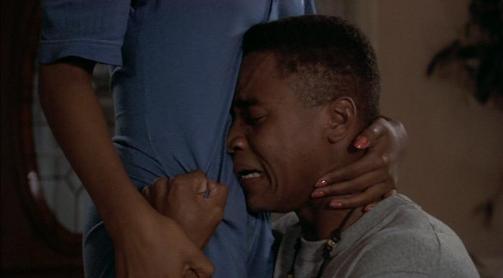
Image result for boyz n the hood crying

 Throughout the film, the narrative follows Tre's struggles with this dilemma of how to respond to male aggression.  In one moving scene, he reaches the pinnacle of his frustrations and starts punching the air in front of his girlfriend.  Impotent to affect an immediate change in his situation, he cries in front of her, at first embarrassed as it goes against his friends’ ideas of maintaining a powerful persona and position toward women.  However, not responding rashly by adding to the aggression, he enacts his father’s vision of masculinity, which is followed by a symbolic second step towards enacting a masculinity—responsible sex with his girlfriend.  Importantly, he does so sensitively, and, when she expresses a fear of pregnancy, he tells her not to worry—the audience is left to infer that he is using a condom as taught by his father, reinforcing resistance to black masculinity. 


Image result for boyz n the hood setting
Image result for boyz n the hood police


Black culture was both embraced and criticised in this film. Singleton celebrated certain aspects of African American inner-city culture, such as the closeness in community and family. However, despite a strong sense of empathy, the criticisms of the violent culture of  the Los Angeles ghetto outweigh the positives in the film. The  objective was to reveal the constant cycle of murder and the self-fulfilling prophecy due to the pressures of masculinity. In order to do this, Singleton risks reinforcing the stereotype that young black males are violent. Whether or not stereotypes exist in this film is purely subjective, because, for example, Singleton portrays the reality of “the Hood,” but an outsider may view it was stereotypical. Race politics  and arguments are inevitably implied, because Singleton’s film addresses societal problems related to race specifically. Police brutality is a sub-issue alluded to in the film through two scenes  involving a black cop  abusing his authority and threatening the young black males.  For example, a cop pulled Tre and Ricky over and the black cop presses his loaded gun to  Tre’s neck while verbally threatening him. Scenes like this one bring up serious societal problems surrounding race.


A lot of characters in Moonlight assume that masculinity means asserting dominance. Kevin is the first example of this, playing up to an image of a heterosexuality that practically comes across as parody. A similarly humorous sequence occurs in Boyz n the Hood, when Tre (Cuba Gooding Jr) tries to impress his dad with a phony story about a sexual conquest. Kevin attempts to keep up appearances are desperate, especially during a scene on a beach with Chiron. Following the near-admission that he cries, he backtracks and responds: “Nah. I wish I did.” It’s almost comical that even in a scene as intimate as this, Kevin feels the need to maintain his hyper-masculine facade.


Moonlight and Boyz n the Hood may be vastly different in style and tone, but there’s enough re occurring themes for these films to be considered companion pieces of sorts. They are personal, unique and honest explorations of the connection between the hostile environments that young African-American men are met with, and how they respond.

=======================================================


'BEAR'(1993) dir. Steve McQueen

Image result for Steve McQueen Bear

Bear, is a 10 minutes long, silent, and consisted of two naked men, one of them him, wordlessly circling each other, staring and sparring,  Steve McQueen's first major film. From looking at articles the video raises sensitive issues about race, homoeroticism and violence. It depicts two naked men-one of which is the artist-sparing and teasing one another in a confrontation which goes from tenderness and aggression. The film is silent but a series of stares, glances and winks between the protagonists "creates an optical language of flirtation and threat."(Tate)

Image result for Steve McQueen's 'Bear'

The film opens with a close-up, a cinematic convention, shot of one man's shoulder. The camera then moves slowly upwards and to the right, travelling his face with close  proximity that suggesting the camera is feeling across the dents of his face. I think, McQueen may reinforce the idea of the sexuality Black male bringing into the idea of Black men being seen as sexualised objects rather than humans, at certain points, medium shots revealing underneath of the men showing their genitalia maybe to reinforce such ideas but also subvert them as Black men aren't able to freely be open with their sexuality or ability to be intimate sexually or platonic with other men- a sexual empowerment of Black men not represented in culture.

Image result for Steve McQueen Bear

Throughout the film, the disorientating camerawork and silent movement of the two bodies moving across a shaft of light, adds to the existing sense of ambiguity. The ability to have the two characters, black males, moving around caressing each other but also fighting one another playfully depicts the on going relationship of Black men and the inability to not allow the society to justify their own identity, extending into a refusal to appear vulnerable, ‘feminine’ or just plain weird. both Jenkins and Singleton provide a similar answer: it’s not about adhering to or performing specific gender stereotypes, but rather a feeling of independence, and the right to choose a life for one’s self. This would reinforce the idea of McQueen's need to have the video play in an empty space quite and lilting . McQueen states in an interview:  "You are very much involved in what's going on. You are a participant not a passive viewer," and concerning the disconcerting sound of 'Bear' he states "The whole idea of making it a silent piece is so that when people walk into the space they become very much aware of themselves, of their own breathing,"
The viewer is left to watch the scene with the intentions of making their own images and ideas of what it is trying to communicate but the main idea is the two characters are in a world of their own and created their own identifies and unnerved from that of onlookers: "I want to put people into a situation where they're sensitive to themselves watching the piece"

=======================================

'Blaxploitation' genre (1970s)

The genre emerged in the 1970's in the United States and is a hybrid word using Black and exploitation. It targeted urban Black audiences and switched roles from the norm from the general white characters but making them villains and having Black heroes making it socially and politically conscious of it's time. There was the general stereotypes, which did exist, urban setting, drugs , prostitution but also social injustice, racial discrimination, brutality of the police.

Male character in Blaxploitation films characterised as:
-Hypermasculinity
-Virility
-Macho black hero
-Well-dressed
-Sexual prowess
-Sexual empowerment of black men in mainstream culture
-The hero fights against injustice (and/or white men) outside of the legal mechanisms

'Shaft'(1971) dir. Gordon Parks

Image result for Shaft

'Shaft' follows a fairly conventional noir plot. Shaft is hired by local mob boss Bumpy Jonas (Moses Gunn) to find Bumpy’s kidnapped daughter – though not until Shaft has made it clear that he despises everything Bumpy stands for (he tosses one of Bumpy’s men out a window to get the message across). Similarly, the case brings him in contact with a Black Panther-like militant group that he also scoffs at. Shaft is seen to only serves no cause but his own. Even so, he ultimately becomes a uniting force, bringing both of these factions together to face a new enemy threatening the neighborhood: the Italian mafia. This is where the movie’s enlightenment ends, as well as its provocative headiness. The final third follows a well-worn action pattern, with Shaft, of course, taking the lead.

Image result for Shaft movie 1971 walk     Image result for Shaft movie 1971 walk

The picture’s final shot is of Shaft walking alone down the street, offering a bookend of sorts with the walk he took over the opening credits. On that earlier stroll, he passes movie marquees boasting names like Robert Redford and Dean Martin. Shaft saunters right on by, leaving those stars behind, He’s taking us into a whole new era.


This film regales itself on  worshipping its central figure (played with an easy smile and an easier scowl by Richard Roundtree). Isaac Hayes’ Oscar-winning title song sings Shaft’s praises over the opening credits. When he struts across six lanes of New York City traffic, the cars give him the right of way. The first sex scene barely notices the woman on hand: it’s Shaft who poses nude on the couch; it’s Shaft’s (much darker) skin that the camera lingers on; it’s a framed photo of Shaft that the camera drifts toward as the couple goes about their business. 

Image result for Shaft movie 1971 walk

The film is flashy and does posses the traits of using Black people to subvert the images normally seen in noir films, as instead of white actors being seen as the heroes they are the villains and it is a Black man who is put as the protagonist of the film, serving his own justice to crooks and immoral police officers. However, the film still olds notable traits of stereotypes of a Black man as Shaft himself is over bearing and dominating common traits represented on Black men , after slavery, the idea held of Black men of just being seen as bodies is evident, since slavery, Black men have been seen as scary and big which is why many were able to hung and killed just for simply being these traits or even not being evidently masculine (as they were killed too), this maybe due to the director being a whote man representing an image of a Black man, rather than it being a black man as seen in 'Boyz N the Hood' and 'Moonlight'. 

In the documentary, 'Black Hollywood', Jim Brown discusses that blaxploitation films that were under white control and production took advantage of the black audience and black actors, in order to create cheaply produced films which often perpetuated stereotypical images of black men and women; which is evident in 'Shaft'. The ability to just not conform to those stereotypes of Black men isn't seen in many Blaxploitation films because of their time, though flashy and different, they do not refrain from commenting on Black men as overly masculine, scary and angry. 

Robert Staples in his book 'Black masculinity' writes an explanation on how Black masculinity have been influenced and created throughout history. He explains how black men in the US have been unable to earn the same patriarchal privileges attached with the status of being males because of their racial identity. 
“Black men face certain problems related to institutional 9 racism and environments which often do not prepare them very well for the fulfillment of masculine roles. In addition to the problems created by institutional and overt discrimination, they encounter negative stereotyping that exists on all levels about them: being socially castrated, insecure in their male identity, and lacking in a positive self concept”(Staples, 1982:8) Staples concept of the problems black men face helps to show that blaxploitation films worked to perpetuate stereotypical images of black men.

As white masculinity is dominate in our society and thus makes inferior of marginalised  types of masculinity, like black masculinity and female masculinity. “Hegemonic masculinity among whites sustains the institutional oppression and physical terror that have framed the making of masculinity in black 6 communities” (Connell, 1995:80). Connell explains here of the difference between hegemonic masculinity vs. marginalised masculinity and could be used as a way in which blaxploitation films were influences by hegemonic white masculinity to produce the marginalised masculinity show in the films . 


Linked Production final